Swing Trading vs Scalping: Which Forex Style Fits Your Personality?
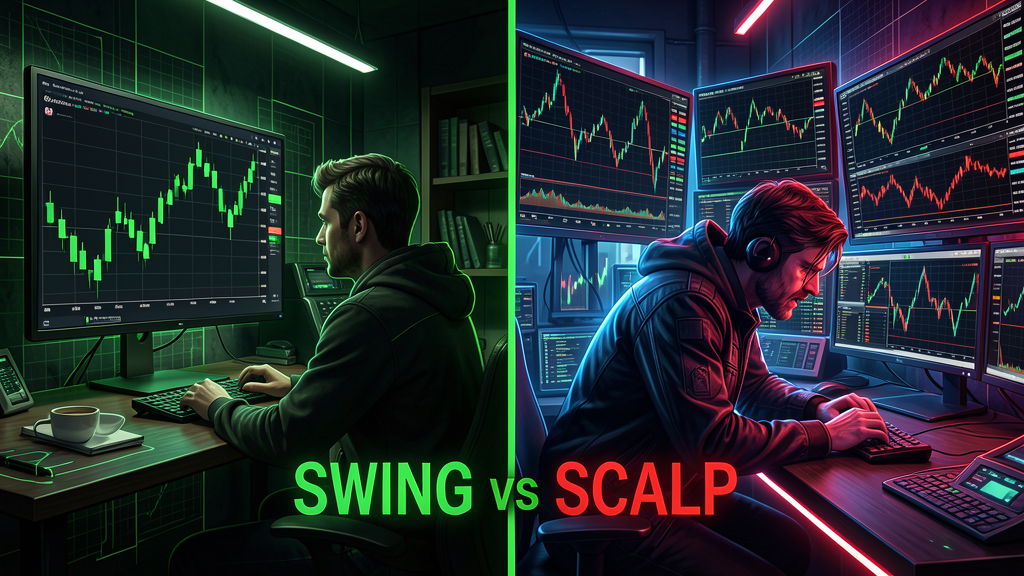
If you're new to forex trading — or even if you've been at it for a while — you've probably heard two terms tossed around: swing trading and scalping. They sit at opposite ends of the trading spectrum, yet both can be profitable. The question isn't which one is "better." It's which one is better for you.
Your trading style should match your personality, your schedule, your risk tolerance, and your financial goals. A scalper forced to hold positions for days will feel like a caged animal. A swing trader who tries to scalp will burn out from the constant screen time. In this guide, we'll break down the core differences between swing trading and scalping, help you assess your own personality type, and give you a clear path to choosing — and testing — the style that fits.
What Is Swing Trading?
Swing trading is a medium-term style where positions are held from a few hours to several days — sometimes weeks. The goal is to capture a "swing" in the market, typically riding a trend or a counter-trend move from a low to a high (or vice versa). Swing traders rely heavily on technical analysis using daily and 4-hour charts. They look for patterns like support and resistance breaks, Fibonacci retracements, and moving average crossovers. They don't need to watch the market every second — a few check-ins per day is often enough.
Key insight: Swing trading is the sweet spot for traders with a day job, a family, or other commitments. You don't need to sit in front of your screen for hours. Set your alerts, check your charts once or twice a day, and let the market come to you.
Most swing traders aim for risk-to-reward ratios of at least 1:2 or 1:3. A typical trade might risk 20–40 pips to capture 60–120 pips over 2–5 days. That means you can have a 40% win rate and still be profitable.
What Is Scalping?
Scalping is the opposite end of the spectrum. Scalpers hold positions for seconds to minutes — rarely more than a few minutes. The goal is to capture tiny price movements, often 5–15 pips per trade, and compound them through high trading volume. Scalping is intense. It requires constant screen attention, lightning-fast reflexes, and the ability to make split-second decisions. Scalpers typically use 1-minute or tick charts, and they rely on order flow, Level 2 data, and ultra-tight spreads.
Key insight: Scalping is not a strategy you can "set and forget." It demands your full attention for the entire trading session. Most successful scalpers trade for 2–4 hours per day, then walk away completely. It's mentally exhausting — but it can be very profitable for the right personality.
Scalpers need high win rates — often 70% or higher — to be profitable because their risk-to-reward ratio is typically close to 1:1. A scalper might risk 5 pips to make 5 pips, relying on their edge and volume of trades to overcome the bid-ask spread.
Swing Trading vs Scalping: The Head-to-Head Comparison
| Factor | Swing Trading | Scalping |
|---|---|---|
| Time Horizon | Hours to days | Seconds to minutes |
| Screen Time | 15–30 min per day | 2–4 hours of intense focus |
| Charts Used | Daily, 4H, 1H | 1-min, tick, order flow |
| Typical Pip Target | 60–120 pips | 5–15 pips |
| Stop Loss | 20–40 pips | 3–8 pips |
| Win Rate Needed | 40–50% | 65–80% |
| Risk-to-Reward | 1:2 to 1:4 | 1:1 to 1:1.5 |
| Trades Per Day | 1–5 | 20–100+ |
| Spreads Matter | Moderately | Critically |
| Best Market | Trending markets | High liquidity, low volatility |
The Personality Test: Which Trader Are You?
Let's be honest with ourselves. The best trading style for you isn't about what sounds cool or what your favorite YouTuber does. It's about your natural tendencies. Ask yourself these questions:
1. How much time can you dedicate to trading each day?
- A) 15–30 minutes — I have a job, family, and other commitments.
- B) 2–4 hours — I can block out time for focused trading sessions.
- C) I'm flexible — I can adapt my schedule.
2. How do you handle pressure?
- A) I prefer calm, deliberate decision-making with time to think.
- B) I thrive under pressure — fast decisions energize me.
- C) I can do both, depending on the situation.
3. What's your attitude toward risk?
- A) I'm fine with a lower win rate if my winners are big.
- B) I need to feel like I'm winning most of the time.
- C) I'm data-driven — I follow whatever the numbers tell me.
4. Do you prefer automation or manual trading?
- A) I'd love to automate my strategy so I don't have to watch the screen.
- B) I want to be in control of every entry and exit.
- C) A mix of both — automated signals with manual execution.
Scoring: Mostly A's? You're a natural swing trader. Mostly B's? Scalping might be your calling. Mostly C's? You have the flexibility to succeed at either — lucky you.
Pros and Cons of Each Style
Swing Trading Pros
- Less screen time, lower stress
- Compatible with a full-time job
- Lower transaction costs (fewer trades)
- Easier to automate with platforms like Travia
- More forgiving of spread and slippage
Swing Trading Cons
- Positions held overnight carry gap risk
- Slower feedback loop — slower learning
- Requires patience and discipline
- Can be boring for action-oriented personalities
Scalping Pros
- High win rate (psychologically rewarding)
- No overnight risk — flat before bed
- Fast feedback — rapid skill development
- Compounds small edges into consistent income
Scalping Cons
- High stress and mental fatigue
- Transaction costs eat into profits significantly
- Requires a fast, reliable broker and low spreads
- Hard to automate effectively
- Not suitable for small accounts (spread kills returns)
Which Style Makes More Money?
This is the million-dollar question — and the answer might surprise you. Neither style is inherently more profitable. Both can produce excellent returns in the right hands. Both can blow up an account in the wrong ones.
What matters is your edge, discipline, and risk management. A top-tier swing trader with a 40% win rate and a 1:3 risk-to-reward ratio can generate 20% monthly returns. A top-tier scalper with a 75% win rate and a 1:1 ratio can do the same. The math works out similarly when the edge is real.
Where they differ is scalability. Swing trading is easier to scale because you can run multiple strategies across different pairs with smaller position sizes. Scalping, by contrast, hits liquidity constraints more quickly — you can't scalp 100 lots on EUR/USD the same way you can scalp 1 lot.
How to Test Both Styles Without Risking Real Money
Here's the smartest thing you can do: test both styles before committing. Your gut feeling about which style suits you might be wrong. The only way to know for sure is to put real data behind it.
With Travia's backtesting engine, you can build and test swing trading strategies and scalping strategies side by side. Run them against years of historical data. See which one produces better risk-adjusted returns, which one fits your schedule, and which one you actually enjoy executing.
Better yet, Travia's forward testing mode lets you run both strategies in real-time market conditions with virtual money. You can trade a swing strategy on GBP/USD and a scalping strategy on EUR/USD simultaneously, tracking performance without risking a single dollar of your capital. Start free at travia.pro/register.
Practical Tips for Each Style
If You Choose Swing Trading:
- Focus on higher timeframes. The daily and 4-hour charts are your best friends. Ignore the noise on lower timeframes.
- Use wider stops. Swing trading needs breathing room. A 20-pip stop on a daily chart is asking to get stopped out. Use ATR-based stops.
- Automate your entries. Platforms like Travia let you set up automated entry rules based on your strategy, so you don't need to watch the charts all day.
- Keep a trading journal. With fewer trades, each one matters more. Document every swing trade and review weekly.
- Manage overnight risk. Use guaranteed stops or reduce position size before major news events.
If You Choose Scalping:
- Choose the right broker. You need ECN/STP pricing with raw spreads and low commissions. Every 0.1 pip of spread is profit you're giving away.
- Trade the most liquid pairs. EUR/USD, GBP/USD, USD/JPY, and USD/CHF during peak London and New York sessions.
- Limit your trading hours. Scalping for more than 3–4 hours a day leads to mental fatigue and bad decisions. Set a time limit.
- Track your metrics obsessively. Win rate, average win, average loss, expectancy, and Sharpe ratio. If your expectancy drops below zero, stop and review.
- Don't revenge trade. After a losing scalp, step away. The urge to "win it back" in the next 30 seconds is the fastest way to blow up.
A Note on Automation
One of the biggest advantages of modern forex trading is that you don't have to choose strictly between swing trading and scalping — you can automate both. With Travia, you can build algorithmic strategies for any timeframe and any style, then let the bot execute them while you sleep, work, or live your life.
Automation is especially powerful for swing traders because it eliminates the "monitoring tax" — the constant urge to check charts and second-guess your analysis. Set your rules, let the bot execute, and review performance at the end of the week. For scalpers, automation is harder but not impossible. High-frequency strategies require low-latency infrastructure, but medium-frequency scalping (holding for 2–5 minutes) can be automated effectively with properly designed rules.
Final Verdict: Which Style Should You Choose?
Here's the honest truth: most traders start with one style and eventually blend elements of both. You might start as a swing trader, then develop a scalping strategy for high-probability setups on lower timeframes. Or you might start as a scalper and realize that holding positions a bit longer captures more of the move.
But if you're starting from scratch, here's our recommendation:
- Start with swing trading if you have a full-time job, prefer a methodical approach, or want to automate your trading.
- Start with scalping if you have 2–4 hours of focused time each day, thrive on fast-paced action, and can handle the emotional intensity.
- Start with both (using paper trading) if you're genuinely unsure — let the data decide.
Whatever you choose, remember one thing: consistency beats intensity. A swing trader who executes their plan for 12 months will outperform a scalper who burns out in 3 months every single time. Choose the style you can sustain, not the one that sounds the most exciting.
Now go build your strategy — and happy trading.