Manual vs Algorithmic Forex Trading: Which Path Is Right for You?
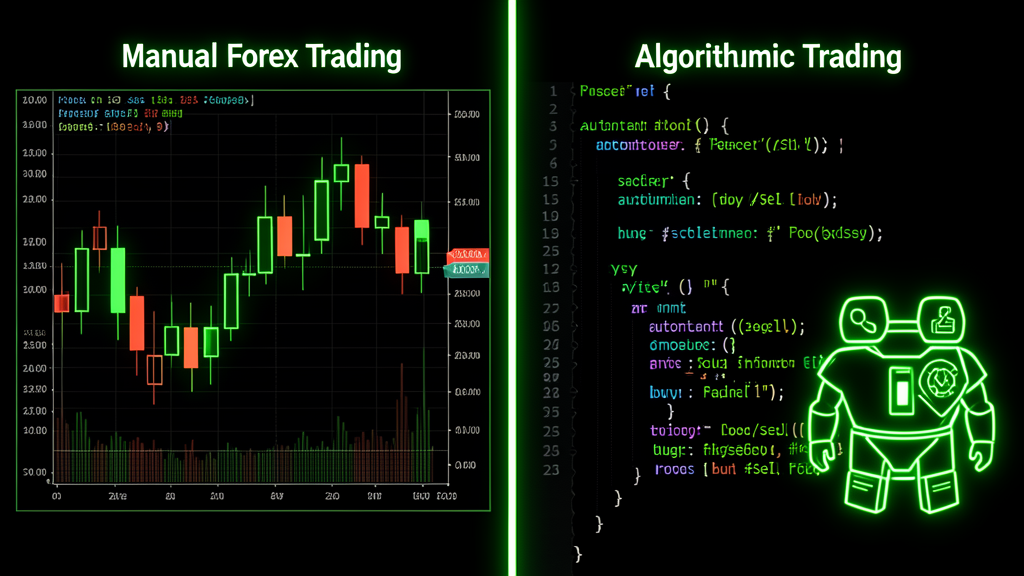
Here's a question I get asked almost daily: "Should I trade manually, or should I learn to code and let algorithms handle it?"
It's one of the most important decisions a trader can make — and there's no single right answer. Manual trading and algorithmic trading are fundamentally different philosophies, each with its own strengths, weaknesses, and ideal practitioner profiles.
In this post, I'm going to break down the manual vs algorithmic forex trading debate in plain English. No jargon bombs, no gatekeeping. Just a clear-eyed look at what each approach demands, what it offers, and — most importantly — which one is right for you.
What Is Manual Forex Trading?
Manual trading is exactly what it sounds like: a human sitting in front of a chart, analyzing price action, identifying setups, and clicking buy or sell. Every decision — entry, exit, stop-loss, take-profit — is made by a person in real time.
This is how forex trading has worked for decades. You bring your experience, intuition, and discipline to the table, and you execute trades based on your judgment in the moment.
What manual trading requires:
- Screen time — lots of it. You need to be present when setups appear.
- Emotional control — you'll feel every drawdown in your gut.
- Pattern recognition — the ability to spot recurring setups across different pairs and timeframes.
- Discipline — the hardest part. Sticking to your plan when your brain is screaming otherwise.
What Is Algorithmic Forex Trading?
Algorithmic trading (often called algo trading or automated trading) means using computer programs to execute trades based on predefined rules. You define the logic — "if X happens, do Y" — and the computer handles the execution without any human intervention.
This is what platforms like Travia specialize in. You build your strategy using visual tools or code, backtest it against historical data, forward-test it in a simulated environment, and once you're confident, let it run live with real capital.
What algorithmic trading requires:
- Strategy clarity — your rules must be 100% precise. "Buy when it looks bullish" won't work.
- Backtesting skills — you need to understand how to validate a strategy without overfitting.
- Technical literacy — not necessarily coding (Travia lets you build visually), but comfort with logic and parameters.
- Patience — developing and validating a robust algo takes weeks or months, not days.
The Great Comparison: Manual vs Algorithmic
Let's get into the meat of it. Here's how the two approaches stack up across the dimensions that actually matter.
Emotional Discipline
Winner: Algorithmic. This isn't even close. Algorithms have zero fear, zero greed, and zero FOMO. They don't hesitate on entries, they don't move stop-losses out of panic, and they don't close winners early because they're "good enough." If you struggle with emotional trading — and most of us do — algorithmic trading is a massive advantage.
Manual traders can develop emotional discipline through practice, but it's a lifelong battle. Even veteran traders have bad days where their psychology slips.
Flexibility and Adaptation
Winner: Manual. Markets change. Regimes shift. A strategy that worked in a trending market can get shredded in a range-bound one. Manual traders can adapt instantly — they see the market changing and adjust their approach on the fly.
Algorithms, by contrast, follow their rules blindly. If the market regime shifts, your algo keeps executing the same logic until you intervene. This is why monitoring and periodic re-optimization are essential for algorithmic trading.
Time Commitment
Winner: Algorithmic (eventually). Manual trading demands active screen time. You can't trade the London session from bed unless you wake up for it. Algos trade 24/7 without ever needing a coffee break.
However, the initial time investment for algo trading is higher. You spend weeks or months building and testing before you deploy. Manual traders can start trading their first setup today.
Backtesting and Data
Winner: Algorithmic. Manual traders can't truly backtest — they can "paper trade" forward, but they can't simulate 10 years of data in an afternoon. Algorithmic strategies can be tested against decades of historical data, giving you statistically meaningful metrics: win rate, profit factor, Sharpe ratio, maximum drawdown, and more.
This is arguably the single biggest advantage of algorithmic trading. You know before you risk real money whether your strategy has an edge.
Scalability
Winner: Algorithmic. A manual trader can realistically monitor 3-5 pairs and execute a handful of trades per day. An algorithmic system can simultaneously trade dozens of pairs across multiple timeframes, 24 hours a day. It scales linearly with compute power, not human attention span.
The X-Factor: Intuition
Winner: Manual. Experience creates intuition. Veteran manual traders develop a "feel" for the market — they sense when a move is running out of steam, when a breakout is fake, when volatility is about to spike. This is almost impossible to codify into an algorithm.
Some algo traders try to capture this with sentiment analysis, volatility filters, or machine learning, but pure human pattern recognition remains unmatched for certain types of market analysis.
Which One Should You Choose?
Here's my honest framework for deciding:
Go manual if:
- You enjoy the process of analyzing charts and making decisions
- You have 2-4 hours of focused screen time per day
- You have strong emotional discipline (or are willing to work on it)
- You trade higher timeframes (4H, daily) and don't need to react to every tick
- You want to start trading today
Go algorithmic if:
- You want a systematic, repeatable approach
- You struggle with emotional trading (like most of us)
- You want to trade multiple pairs or strategies simultaneously
- You value data-driven decision making over gut feel
- You're willing to invest time upfront for long-term consistency
Do both if: This is honestly the sweet spot for many successful traders. Use manual analysis to develop market intuition and identify broader trends. Build algorithmic systems to execute specific, well-defined strategies. Let the algo handle the grunt work while you focus on strategy and oversight.
On Travia, you can actually combine both approaches — manually analyze the market using real-time data and forward-testing environments, then deploy your refined strategies as automated systems. It's the best of both worlds.
Common Myths About Algorithmic Trading
Myth 1: "You need to be a programmer."
Not anymore. Platforms like Travia offer visual strategy builders where you drag and drop conditions — no code required. You define your entry rules, risk parameters, and exit conditions through an intuitive interface. Coding knowledge helps but is not a barrier to entry.
Myth 2: "Algos are only for big institutions."
False. Retail algorithmic trading has exploded in the last five years. With cloud-based platforms and affordable compute, individual traders have access to tools that were reserved for hedge funds a decade ago.
Myth 3: "Set it and forget it — passive income!"
This is the most dangerous myth. Algos need monitoring. They need periodic re-optimization. Market regimes shift, and a strategy that worked last year might be bleeding pips right now. Algorithmic trading is a management activity, not a passive income stream.
Myth 4: "Manual trading is more profitable."
There's no evidence for this. Profitable traders exist in both camps. The differentiator isn't manual vs algorithmic — it's having a defined edge and executing it consistently. Algorithms just happen to be better at the "consistent execution" part.
How to Start: A Practical Roadmap
Whether you go manual, algorithmic, or both, here's a progression that works:
- Learn the basics. Understand forex fundamentals — pips, lots, leverage, spreads, order types. This is table stakes for both approaches.
- Paper trade manually. Even if you plan to go algorithmic, spend 2-4 weeks manually paper trading to develop a feel for how markets move. Use Travia's forward-testing environment.
- Define your edge. What makes you money? Is it trend following? Mean reversion? Breakout trading? Define your core concept in clear, rule-based terms.
- Backtest it. Run your rules against historical data.Travia's backtesting engine makes this easy — no coding required.
- Forward-test it. Run the system in a simulated environment with live market data. Track every trade. Measure your metrics.
- Go live small. Start with minimal risk. A 0.5% risk-per-trade approach, even on a small account, gives you room to validate your strategy with real capital.
- Scale up. Once verified, increase position sizes proportionally. Let compounding do the heavy lifting.
The Bottom Line
The manual vs algorithmic forex trading debate doesn't have a universal winner. The best approach is the one that fits your personality, your schedule, and your goals.
If you love the craft of reading charts and have the discipline to follow your rules, manual trading can be deeply rewarding. If you prefer systematic execution, data-driven decisions, and the ability to trade while you sleep, algorithmic trading is the natural fit.
And if you're somewhere in between? Use both. Let algorithms handle the mechanical execution while you focus on strategy, analysis, and continuous improvement.
That's the beauty of modern forex trading — you're not locked into one approach. You can build a system that works for you.
Ready to build yours? Start forward-testing on Travia for free — whether you trade manually, algorithmically, or both.
Frequently Asked Questions
Is algorithmic trading more profitable than manual trading?
Not inherently. Profitability depends on having a strategy with a statistical edge, not on the execution method. Algorithms excel at consistent execution; humans excel at adaptation. The most profitable traders often combine both.
Do I need to know Python to algo trade?
No. Platforms like Travia offer visual strategy builders that let you create trading rules without writing code. However, knowing Python or MQL5 gives you more flexibility for advanced strategies.
Can I switch from manual to algorithmic trading?
Absolutely — and many successful traders do. Your manual trading experience gives you invaluable market intuition that you can codify into algorithmic rules. Start by automating your simplest, most rule-based setups.
How much capital do I need for algorithmic forex trading?
You can start forward-testing algorithmic strategies on Travia with zero capital. For live trading with a broker, most require a minimum deposit of $100-$500 for standard accounts, though some micro accounts allow smaller starts.
What's the biggest risk of algorithmic trading?
Over-optimization (curve-fitting) and regime change. A strategy that's perfectly tuned to past data may fail in live markets. Always forward-test, and never deploy a strategy you don't fully understand.