The Complete Guide to Forex Position Sizing: Protect Your Capital \& Maximize Returns
If there's one thing that separates professional traders from gamblers, it's position sizing. You can have the best trading strategy in the world — perfect entry timing, flawless technical analysis, an edge that would make a quant weep — but if you get your position sizing wrong, your account will eventually hit zero.
Position sizing is the art and science of deciding how much to risk on any single trade. It's the single most important risk management tool in a forex trader's toolkit, yet it's the one most beginners overlook in their rush to find the perfect entry signal.
In this guide, I'll walk you through the core concepts of forex position sizing, the most reliable methods professional traders use, and how to implement them in your own trading — whether you're on Travia, MT5, or any other platform.
Why Position Sizing Matters More Than Your Entry
Let me hit you with a hard truth: a great strategy with bad position sizing will lose money. A mediocre strategy with great position sizing will make money.
Here's why. Imagine you have a strategy that wins 60% of the time with a 1:1 risk-reward ratio. Sounds solid, right? But if you risk 50% of your account on each trade, a single losing streak of just two trades in a row wipes out 75% of your capital. Three losses? You're down 87.5%. Your account is essentially dead.
Now take the same 60% win-rate strategy but risk 1% per trade. You could lose ten trades in a row and still have 90% of your capital left — plenty to recover. That's the power of proper forex position sizing.
The Core Principle: Risk Per Trade, Not Lot Size
The biggest misconception new traders have is that position sizing is about choosing a lot size — "I'll trade 0.1 lots" — and that's it. It's not. Position sizing is about defining your risk first, then calculating the lot size that matches that risk.
The order should always be:
- Decide how much of your account you're willing to lose on this trade (your risk %)
- Measure the distance from entry to stop-loss in pips
- Calculate the position size (lot size) that makes the pip distance equal to your chosen dollar risk
This is the fixed percentage method — the gold standard of forex position sizing — and every professional trader uses some variation of it.
Method 1: Fixed Percentage Position Sizing
This is where you should start. The idea is simple: risk a fixed percentage of your account on every trade. Most professionals recommend 1-2% per trade. Conservative traders stick to 0.5-1%; aggressive traders might push to 2-3% but rarely more.
Let's walk through a real example.
Scenario:
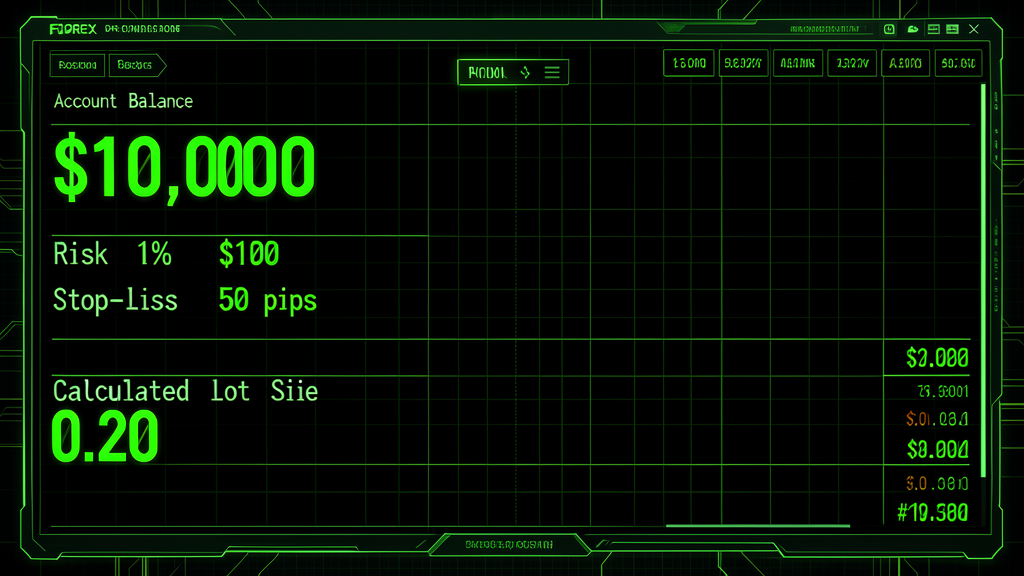
- Account balance: $10,000
- Risk per trade: 1% ($100)
- Currency pair: EUR/USD
- Entry: 1.1050
- Stop-loss: 1.1000 (50 pips)
Calculation:
- Risk = $100
- Stop distance = 50 pips
- Value per pip needed = $100 ÷ 50 = $2 per pip
- On EUR/USD, 1 standard lot (100,000 units) = $10 per pip
- So: $2 ÷ $10 = 0.2 lots (or 2 mini lots)
You'd enter with 0.20 lots, and if price hits your stop, you lose exactly $100 — 1% of your account. That's controlled, predictable risk.
The beauty of this method is that it scales naturally with your account. As your account grows, your position sizes grow proportionally (compounding your gains). As your account shrinks, your risk automatically reduces (preserving your remaining capital).
Method 2: The Kelly Criterion
The Kelly Criterion is a more mathematical approach developed by John Kelly at Bell Labs in the 1950s. It tells you the optimal fraction of your account to risk based on your historical win rate and average win/loss ratio.
The formula is:
Kelly % = W - [(1 - W) ÷ R]
Where:
- W = Win rate (as a decimal, e.g., 0.60 for 60%)
- R = Average win / Average loss (the reward-to-risk ratio)
Example: If you win 55% of your trades and your average win is 1.5× your average loss:
Kelly % = 0.55 - (0.45 ÷ 1.5) = 0.55 - 0.30 = 0.25
The Kelly Criterion says to risk 25% of your account per trade.
Now, a word of warning: Full Kelly is extremely aggressive. Most traders use "Fractional Kelly" — typically 25-50% of the Kelly number — to reduce volatility. In the example above, half-Kelly would be 12.5%, which is still quite aggressive. Most retail traders using Kelly will take 10-25% of the full Kelly result, giving them something in the 1-3% range.
Method 3: Volatility-Based Position Sizing
Also known as the ATR (Average True Range) method, this approach ties your position size to market volatility. When the market is calm (low ATR), you take larger positions. When it's choppy (high ATR), you shrink your size.
This makes intuitive sense: you shouldn't trade the same size in a quiet Asian session EUR/USD as you do during a red-hot NFP announcement.
How it works:
- Calculate ATR on your chosen timeframe (typically 14-period ATR on the daily chart)
- Set your stop-loss at, say, 2× ATR from entry (a volatility-based stop)
- Use the fixed percentage formula above, where the stop distance = 2 × ATR
This way, your position size naturally shrinks in volatile markets and expands in calm ones, keeping your dollar risk consistent regardless of market conditions.
How to Implement Position Sizing on Travia
If you're using Travia for forward-testing your strategies, you're in luck — the platform handles position sizing calculations automatically when you set your risk parameters.
Here's how to set it up:
- Set your account balance in your Travia dashboard
- Define your risk percentage (start with 1%)
- Place your stop-loss based on technical levels (support/resistance, ATR, etc.)
- Travia automatically calculates the correct lot size to match your risk
What I love about this workflow is that it forces you to think about risk before reward. On Travia, you can forward-test thousands of trades with proper position sizing baked in, giving you realistic performance metrics from day one.
Common Position Sizing Mistakes to Avoid
1. The "I'll Just Wing It" Approach
Not having a predefined position sizing formula is the fastest way to blow up an account. If you're deciding lot sizes based on "feeling," you're gambling, not trading.
2. Over-Leveraging Small Accounts
A $500 account with 1:100 leverage can trade 0.5 lots — a massive position relative to the account. Just because you can doesn't mean you should. Stick to your 1% rule.
3. Increasing Size After Losses (The Martingale Trap)
Doubling down after a loss to "get it back quickly" is a classic recipe for disaster. If you lose, stick to your predetermined risk percentage. Don't chase.
4. Increasing Size After Wins (The Overconfidence Trap)
Conversely, a few big wins can make you feel invincible. Don't start increasing your risk percentage just because you're on a hot streak. Consistency is key — let compounding do the work.
The Bottom Line
Forex position sizing is the single most important risk management skill you can develop. It won't improve your win rate or your risk-reward ratio, but it will ensure you survive long enough for your edge to play out. And in trading, survival is everything.
If you take nothing else away from this guide, remember this: decide your risk before you decide your lot size. Your future self — sitting on a steadily growing account — will thank you.
Ready to put this into practice? Start forward-testing with proper position sizing on Travia — it's free to create an account and you can begin testing your strategies immediately.
Frequently Asked Questions
What is the best position sizing method for beginners?
Start with the fixed percentage method at 1% per trade. It's simple, effective, and easy to calculate. Once you're comfortable, explore the ATR-based or fractional Kelly methods.
How do I calculate position size manually?
Risk ($) ÷ Stop distance (pips) = Value per pip. Then divide by the pip value for 1 standard lot ($10 for most major pairs) to get your lot size. Most trading platforms, including Travia, automate this.
Should I use different position sizes for different strategies?
Yes. If you have a high-win-rate scalping strategy (70%+) and a lower-win-rate swing strategy (45%), each deserves its own risk calculation. Track them separately and apply the appropriate sizing.
Does position sizing change with account size?
Yes — that's the point. As your account grows, your risk per trade grows proportionally, letting you compound returns. As it shrinks, your risk reduces, helping you preserve capital.